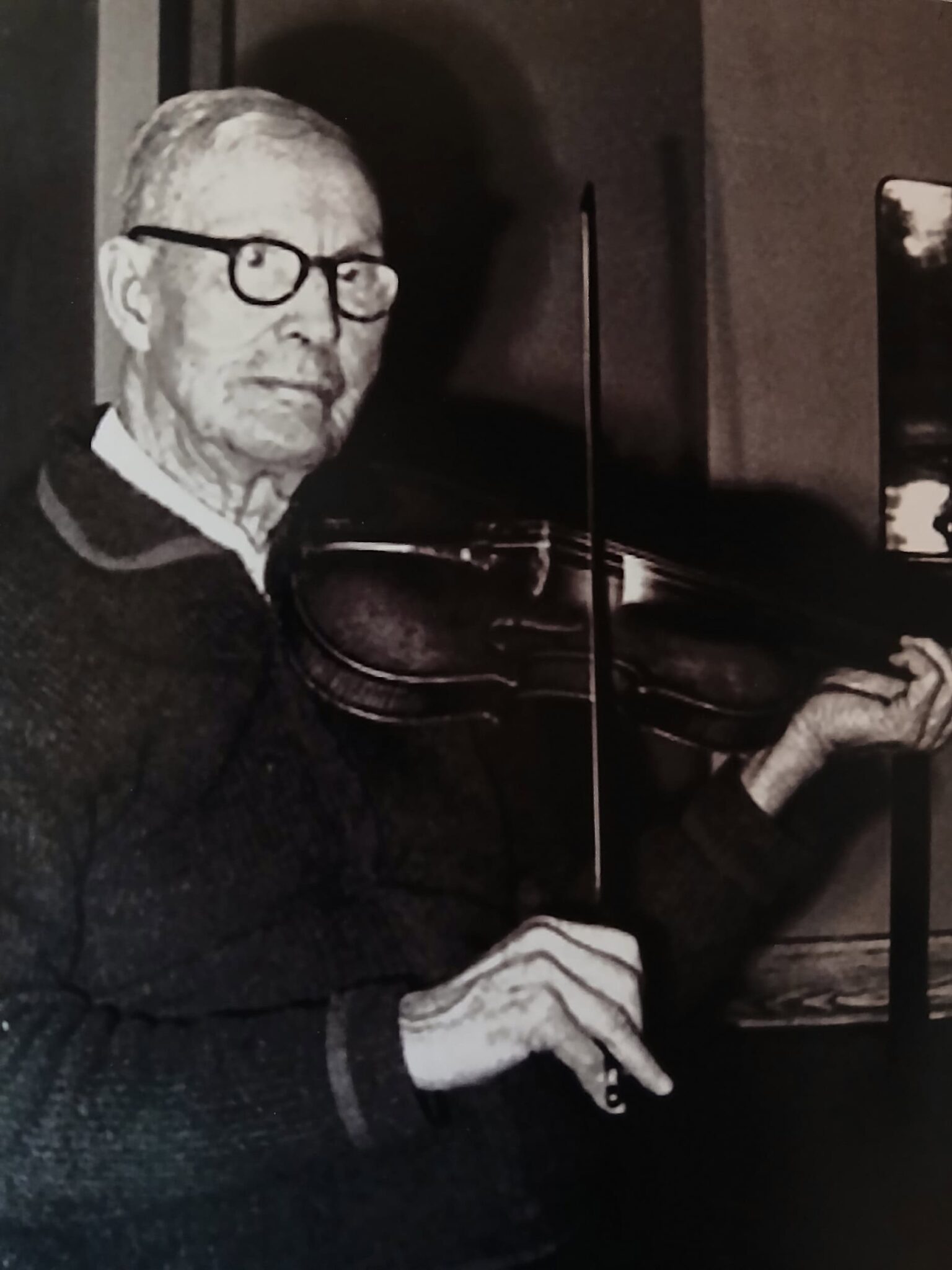
John Allan MacMillan’s story is, at its heart, the story of Glengarry itself, its families, its music, and its deep Celtic traditions carried forward by ordinary people with extraordinary gifts. Born in 1870 in Finch Township, MacMillan came from a lineage deeply rooted in the region’s early Scottish settlement. As a grandson of “Roman John” MacMillan, one of Stormont County’s early pioneers and part of the Lochinvar MacMillan line, John Allan inherited both a strong cultural identity and a musical heritage that would shape his life and legacy. In 1899 he married Julia Campbell of Kenyon Township, and together they raised eleven children, many of whom became musicians themselves.
Though he worked professionally as a bridge master in Mille Roches, MacMillan’s true renown came from his fiddle. His name appears repeatedly in early editions of The Glengarry News, documenting decades of performances at concerts, socials, and community gatherings across the county. During the 1920s and 1930s he was a regular competitor in the Highland Society’s violin competitions, consistently placing first or second. These results weren’t simply accolades; they were public recognition of a musician whose skill, tone, and stylistic authenticity set him apart.
Remarkably, a 1956 tape recording captures MacMillan at age 86, still playing with clarity, strength, and expressive nuance. Even in his later years he demonstrated true intonation, tasteful embellishments, and the confident use of double stops and droning, hallmarks of the older Scottish fiddle tradition. Bruce Ross, who visited him during this period, recalled being struck by the richness of his sound. The recording also reveals something important about MacMillan’s musical character: he continued learning new material well into old age. Alongside classic Scottish repertoire, he played more contemporary tunes, including “The El Alamein,” a 6/8 pipe march composed near the end of the Second World War. This willingness to stay current shows a musician who was not merely preserving tradition but actively engaging with its evolution.
In the 1940s and 1950s, MacMillan also played regularly with Father McPhail’s group, further cementing his role in the region’s musical life. His playing drew the attention of George Proctor, a musicologist with the National Museum of Canada, who recorded him in 1960 as part of a major study on Ontario’s traditional fiddling. Proctor’s inclusion of MacMillan underscores his importance as a bearer of authentic Scottish-Canadian musical tradition.
A 1975 Chesterville Record article adds a vivid personal dimension to his legacy. It describes the spontaneous house parties where MacMillan’s children, nine of whom played fiddle, could pass a violin around the circle without missing a beat. The music would go on all night, rugs rolled up, neighbours like the Camerons dropping in, and old tunes such as “Road to the Isles” and “MacCrimmon’s Lament” filling the room. These scenes capture the living tradition MacMillan embodied: music as community, continuity, and joy.
Taken together, John Allan MacMillan emerges as a foundational figure in Glengarry’s musical heritage. He was a master fiddler, a tradition bearer, and a man whose influence extended through his family, his community, and the historical record. His induction into the Glengarry Celtic Music Hall of Fame is not only fitting but deeply deserved.